Autumn & Winter Readiness: Fall and Cold Weather Preparation for Home, Family, and Health

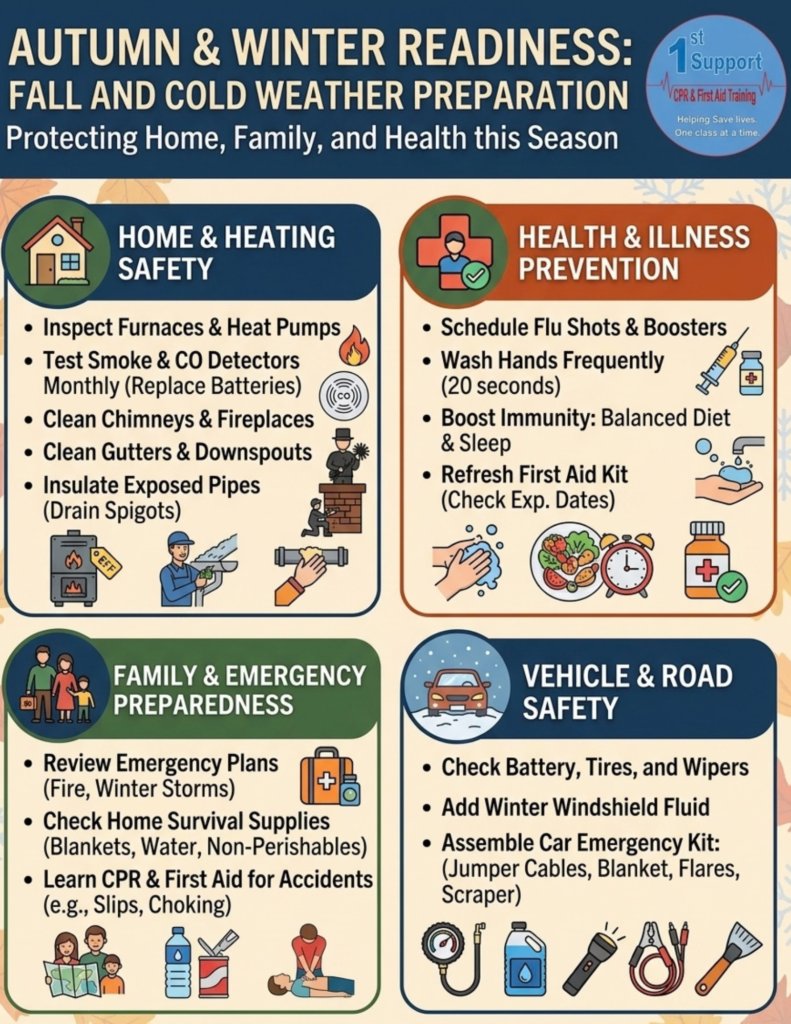
As temperatures drop and the autumn breeze sets in, preparing for the colder months becomes essential. Cold weather brings unique health risks, home maintenance needs, and safety challenges—from seasonal illnesses to slippery walkways and indoor hazards. Taking a proactive approach during early fall ensures your home stays safe, your family remains healthy, and you are prepared for seasonal emergencies.

1. Seasonal Health & Illness Prevention


Colder weather often keeps people indoors, where viruses spread more easily. Flu season peak coincides with late autumn and winter, making health precautions a top priority.

Immune Support: Prioritize balanced nutrition, regular exercise, adequate sleep, and hydration.

Stay Up to Date on Vaccinations: Consult your healthcare provider regarding annual flu shots and recommended seasonal boosters.

Hand Hygiene: Encourage frequent handwashing with warm water and soap for at least 20 seconds to prevent the spread of respiratory germs.

First Aid Kit Refresh: Check expiration dates on over-the-counter cold medicines, fever reducers, throat lozenges, and basic first aid supplies.

2. Home & Heating Safety Checks


Heating equipment is one of the leading causes of home fires during winter months. A few maintenance checks around your home can prevent costly repairs and dangerous hazards.

Inspect Heating Systems: Have furnaces, boilers, and heat pumps serviced by a professional before turning them on for the season. Clean or replace air filters regularly.

Test Smoke and Carbon Monoxide Detectors: Fuel-burning appliances and fireplaces increase the risk of carbon monoxide (CO) poisoning. Test detectors monthly and replace batteries annually.

Fireplace & Chimney Maintenance: Schedule an annual chimney sweep to remove creosote buildup before lighting your first fire.

Space Heater Safety: Keep portable heaters at least 3 feet away from flammable items (curtains, bedding, furniture). Never plug space heaters into extension cords or power strips; plug them directly into wall outlets.

3. Winterising Your Property & Outbuildings


Protecting your exterior home structures prevents winter freeze damage and outdoor hazards.

Clear Gutters and Downspouts: Remove leaves and debris to ensure rainwater flows freely, preventing ice dams and water intrusion along your roofline.

Drain Exterior Faucets & Hoses: Disconnect garden hoses, drain remaining water, and insulate outdoor spigots using free

Draftproofing: Install weather stripping around doors and windows to keep heat in and reduce utility costs.

Trim Tree Branches: Cut back dead or overhanging limbs that could snap under heavy ice or wind, threatening roof structures or power lines.

4. Vehicle & Emergency Roadside Preparation


Cold weather impacts vehicle performance, battery health, and tire pressure. Preparing your car early ensures you aren’t stranded during sudden inclement weather.

Check Vehicle Fluids & Battery: Cold temperatures drop battery power significantly. Have your battery tested and top off windshield washer fluid with a winter formula that resists freezing.

Inspect Tires: Ensure tires have adequate tread depth and maintain correct inflation levels, as air pressure drops naturally in colder air.

Assemble an Auto Emergency Kit: Keep a dedicated winter safety kit in your trunk containing:

Blanket and warm clothing (gloves, hats)

Ice scraper and snow brush

Flashlight with fresh batteries

Jumper cables

Portable power bank for mobile phones

Non-perishable snacks and bottled water

5. First Aid & Safety

Preparedness in Cold Weather
Cold weather increases the risk of hypothermia, frostbite, slipping accidents, and indoor medical emergencies. Knowing how to recognize and respond to these situations is crucial.

Recognizing Cold Exposure:

Frostbite: Look for numbness, loss of feeling, and pale, waxy, or hard skin (commonly affecting fingers, toes, nose, and ears). Move the individual indoors and warm the affected area gently with warm (not hot) water.

Hypothermia: Symptoms include uncontrollable shivering, slurred speech, confusion, and lethargy. Call 911 immediately, cover the person with dry blankets, and provide warm, non-alcoholic liquids if conscious.

Keep CPR & First Aid Skills Sharp: Emergency response times can slow down during severe weather events like ice or snowstorms. Being certified in CPR and basic first aid empowers you to care for family members or neighbors until help arrives.

Is your household ready for the cold weather season? Make emergency preparedness a priority this autumn. Contact First Support CPR at info@firstsupportcpr.com or browse our schedule to take or renew your CPR and First Aid certifications today!
Hands-Only vs. Traditional CPR: Knowing the Difference and Finding Your Rhythm

When a cardiac emergency strikes, every second counts. Knowing how to perform Cardiopulmonary Resuscitation (CPR) can double or even triple a person’s chance of survival. However, many bystanders hesitate to step in because they feel unsure about the proper technique or uncomfortable giving rescue breaths.

Understanding the difference between Hands-Only CPR and Traditional CPR—along with a simple trick to keep the right pace—can empower you to step up and save a life with confidence.

What is Hands-Only CPR?

Hands-Only CPR (also known as compression-only CPR) consists of continuous, high-quality chest compressions without rescue breathing.

The Two Steps

  1. Call 911 (or send someone else to call and retrieve an AED).

  2. Push hard and fast in the center of the victim’s chest.

When to Use It

Hands-Only CPR is recommended for teens or adults who suddenly collapse in an out-of-hospital setting. During the first few minutes of a sudden cardiac arrest, the person’s blood still contains residual oxygen. The primary goal is to manually pump that oxygenated blood to the brain and vital organs until professional medical help arrives.

What is Traditional CPR?

Traditional CPR combines chest compressions with rescue breathing. It follows a specific ratio: 30 chest compressions followed by 2 rescue breaths.

When to Use It

While Hands-Only CPR is great for sudden adult collapse, Traditional CPR is necessary in specific scenarios where lack of oxygen is the main issue:

  • Infants and Children: Cardiac arrest in children is most often caused by respiratory failure rather than a sudden heart issue, making rescue breaths crucial.

  • Drowning, Suffocation, or Overdose: Victims who suffered oxygen deprivation need rescue breathing to restore oxygen levels in the blood.

  • Unresponsive Unwitnessed Arrests: If an adult has been non-responsive for an unknown period, oxygen levels in their bloodstream may already be depleted.

Finding the Beat: The 100 to 120 BPM Rule

For chest compressions to be effective, they must be delivered at a rate of 100 to 120 beats per minute (BPM). Pressing too slowly fails to move enough blood, while pressing too fast prevents the heart chamber from refilling properly between compressions.

Remembering a specific tempo during a high-stress crisis can be difficult. The solution? Push to the beat of a familiar song.

The Ultimate Life-Saving Playlist

You don’t need a metronome—just hum one of these recognizable 100–120 BPM tracks to maintain the correct rhythm:

  • 🕺 “Stayin’ Alive” – Bee Gees (103 BPM – The classic standard)

  • 👑 “Another One Bites the Dust” – Queen (110 BPM)

  • ☕ “Espresso” – Sabrina Carpenter (104 BPM)

  • 🕺 “Uptown Funk” – Mark Ronson ft. Bruno Mars (115 BPM)

  • 🎧 “Levitating” – Dua Lipa (103 BPM)

  • 🦈 “Baby Shark” – Pinkfong (115 BPM)

  • 💃 “I Wanna Dance with Somebody” – Whitney Houston (119 BPM)

Practice Makes Prepared

Whether you are administering Hands-Only CPR or full Traditional CPR with rescue breaths, taking action is always better than doing nothing.

While knowing these steps is essential, getting hands-on practice in an official certification class gives you the muscular memory and confidence needed in a real emergency.

Want to make sure you’re ready when it counts? Contact First Support CPR today at info@firstsupportcpr.com or visit our course schedule to take or renew your certification!

Every Second Counts: Why the Restart a Heart Campaign Matters More Than Ever

Imagine a family member, a colleague, or a complete stranger suddenly collapsing in front of you. They are unresponsive and not breathing normally. In that critical moment, the actions taken within the first few minutes determine whether they survive.

That is the driving force behind the Restart a Heart campaign—an annual global initiative dedicated to raising awareness about cardiac arrest and empowering everyday people with the lifesaving skills of CPR and defibrillation.

The Stark Reality of Out-of-Hospital Cardiac Arrest

Across the world, hundreds of thousands of people experience an out-of-hospital cardiac arrest every year. Survival rates remain devastatingly low—often under 10%.

The statistics reveal a critical truth:

  • It happens close to home: Around 80% of cardiac arrests occur in domestic settings, meaning the victim is most likely someone you know and love.

  • Time is muscle and brain: For every minute a person in cardiac arrest goes without CPR and defibrillation, their chance of survival drops by up to 10%.

  • Bystanders make the difference: Performing immediate CPR can double or even triple a person’s chances of survival.

Demystifying Lifesaving: The 3 Simple Steps

The primary goal of the Restart a Heart campaign is to break down the fear and hesitation surrounding emergency intervention. You don’t need years of medical training to save a life; you just need to remember three basic steps:

  1. Call: Recognize the emergency immediately, call local emergency services, and put the call on speaker so dispatchers can guide you.

  2. Push: Start Hands-Only CPR. Place your hands in the center of the person’s chest and push hard and fast—at a rate of 100 to 120 compressions per minute.

  3. Shock: If an Automated External Defibrillator (AED) is nearby, send someone to retrieve it. Modern AEDs provide clear, spoken instructions and will only deliver a shock if the victim’s heart rhythm requires it.

How You Can Get Involved

Mark your calendar for October 16th—World Restart a Heart Day. Leading up to and during October, communities, schools, and workplaces host free training sessions and awareness drives.

Here is how you can participate:

  • Take a free online CPR refresher: Digital interactive tools allow you to learn hands-only CPR in as little as 15 minutes right from your phone.

  • Locate local AEDs: Know where defibrillators are installed in your neighborhood, office, or local community centers.

  • Spread the word: Share CPR training resources on social media to help demystify resuscitation for your friends and family.

Doing something is always better than doing nothing. By taking a few minutes to learn CPR today, you become a crucial link in the chain of survival.

Why Basic Life Support (BLS) Training Matters: Be Ready to Save a Life

Every day, ordinary people are faced with extraordinary emergencies. A coworker collapses at the office. A loved one suddenly becomes unresponsive at home. A patient experiences cardiac arrest in a healthcare setting. In these critical moments, knowing what to do can make all the difference.

That’s why Basic Life Support (BLS) training is one of the most valuable certifications you can earn. At First Support CPR & First Aid Training, we believe everyone—especially healthcare professionals and those who care for others—should have the knowledge and confidence to respond when every second counts.

What Is Basic Life Support (BLS)?

Basic Life Support (BLS) is a level of emergency care that focuses on recognizing life-threatening emergencies and providing immediate care until advanced medical help arrives. BLS training equips participants with the skills needed to respond quickly and effectively during cardiac and respiratory emergencies.

A comprehensive BLS course typically covers:

  • High-quality CPR for adults, children, and infants
  • Proper use of an Automated External Defibrillator (AED)
  • Relief of choking in adults, children, and infants
  • Effective team-based resuscitation
  • Rapid assessment and emergency response
  • Communication during medical emergencies

These skills are essential for healthcare providers and are also valuable for anyone who wants to be prepared to help during a life-threatening emergency.

Who Should Take a BLS Course?

Basic Life Support training is recommended for:

  • Nurses
  • Physicians
  • Emergency Medical Technicians (EMTs)
  • Dentists and dental assistants
  • Medical and nursing students
  • Respiratory therapists
  • Physical and occupational therapists
  • Home health providers
  • Healthcare office staff
  • Anyone whose job requires BLS certification

Even if you are not a healthcare professional, learning these life-saving techniques can help you respond confidently if an emergency happens at home, at work, or in your community.

Why Keeping Your BLS Certification Current Is Important

Medical guidelines continue to evolve as new research improves our understanding of resuscitation science. Regular renewal ensures that your skills remain current and effective.

Renewing your BLS certification helps you:

  • Stay up to date with the latest CPR recommendations
  • Maintain confidence in emergency situations
  • Meet employer and licensing requirements
  • Improve teamwork during medical emergencies
  • Practice hands-on skills that can diminish over time

Regular training reinforces muscle memory and prepares you to act quickly when it matters most.

The Difference Between CPR and BLS

Many people ask whether CPR and BLS are the same. While they are closely related, BLS provides more comprehensive training.

A standard CPR course teaches essential life-saving skills for the general public, including chest compressions, rescue breathing, AED use, and choking relief.

BLS includes these core skills while also emphasizing coordinated team response, advanced assessment techniques, and emergency care practices commonly used in healthcare settings.

Flexible Training Designed for Busy Schedules

At First Support CPR & First Aid Training, we understand that healthcare professionals and working adults have demanding schedules.

That’s why we offer hybrid BLS certification courses, allowing you to:

  • Complete the online learning portion at your own pace
  • Attend a convenient in-person skills session
  • Receive hands-on instruction from experienced instructors
  • Earn a nationally recognized certification

Our goal is to make high-quality training accessible without compromising the hands-on practice needed to build confidence.

Be the Person Who Makes a Difference

Emergencies are unpredictable, but your response doesn’t have to be.

Whether you’re caring for patients, protecting your workplace, or supporting your family, Basic Life Support training prepares you to take immediate action during a medical emergency.

The confidence you gain through training could one day help save the life of a patient, coworker, friend, family member, or even a complete stranger.

Train with First Support CPR & First Aid Training

At First Support CPR & First Aid Training, we are committed to providing professional, engaging, and practical instruction for individuals, healthcare providers, businesses, schools, and community organizations throughout San Jose and the surrounding areas.

Our courses include:

  • Basic Life Support (BLS)
  • CPR/AED
  • First Aid
  • First Aid CPR AED
  • Pediatric CPR AED

Whether you’re earning your certification for the first time or renewing an existing one, our experienced instructors are here to help you build the skills and confidence to respond when every second counts.

Ready to Get Certified?

Invest in a skill that can make a lasting difference.

📍 First Support CPR & First Aid Training
Serving San Jose and surrounding communities

📞 (408) 475-7724

Helping save lives, one class at a time.

Why Renewing Your CPR Certification Matters

CPR certification is more than just a card or workplace requirement — it represents the ability to respond confidently during a life-threatening emergency. Whether you are a healthcare provider, teacher, parent, coach, caregiver, or employee, keeping your CPR certification current is essential.

At First Support CPR & First Aid Training, we encourage everyone to stay up to date with their life-saving skills through regular CPR renewal training.

CPR Skills Can Fade Over Time

Even highly trained individuals can forget important steps if CPR skills are not practiced regularly. Studies show that CPR knowledge and confidence can decline within months after certification.

Renewing your certification helps you:

  • Refresh proper chest compression techniques
  • Review rescue breathing procedures
  • Practice AED use
  • Improve reaction time during emergencies
  • Build confidence in high-pressure situations

In an emergency, confidence and quick action can make all the difference.

CPR Guidelines Continue to Evolve

The American Heart Association regularly updates CPR and emergency cardiovascular care guidelines based on new research and medical advancements.

Renewing your certification ensures you stay informed about:

  • Updated compression depth and rate recommendations
  • Hands-Only CPR procedures
  • AED best practices
  • Changes in pediatric and infant CPR
  • New emergency response protocols

Staying current means providing the safest and most effective care possible.

Emergencies Can Happen Anywhere

Cardiac arrest can happen at home, at work, at school, at the gym, or even in public places. In many situations, bystanders are the first people available to help before emergency responders arrive.

Immediate CPR can double or even triple a person’s chance of survival.

Renewing your CPR certification keeps you prepared to step in and

help when every second matters.

Maintain Workplace and Professional Requirements

Many industries require current CPR certification, including:

  • Healthcare professionals
  • Teachers and school staff
  • Childcare providers
  • Fitness trainers
  • Security personnel
  • Workplace safety teams

Allowing your certification to expire may affect compliance requirements for your job or organization.

Renewing on time helps ensure you remain qualified and ready.

Hybrid CPR Training Makes Renewal Easier

At First Support CPR & First Aid Training, we make the renewal process convenient and flexible with hybrid learning options.

Our courses allow students to:

  • Complete the online portion at their own pace
  • Attend a hands-on in-person skills session
  • Receive updated certification quickly and efficiently

We offer:

  • BLS for Healthcare Providers
  • CPR/AED Certification
  • First Aid CPR AED
  • Pediatric CPR AED
  • First Aid Training

Protect Your Family, Workplace, and Community

Renewing your CPR certification is an investment in preparedness. You never know when someone nearby may need immediate help.

Your training could help save:

  • A family member
  • A coworker
  • A child
  • A friend
  • A stranger in your community

Being prepared means being ready to make a difference.

Renew Your CPR Certification Today

At First Support CPR & First Aid Training, our mission is simple:

Helping save lives, one class at a time.

If your certification is expiring soon, now is the perfect time to renew and stay confident in your life-saving skills.

📍 Serving San Jose and surrounding areas
📞 Call or text: (408) 475-7724

Stay certified. Stay prepared. Save lives.

Stay Certified, Stay Ready to Save a Life: Why Renewing Your CPR Certification Matters

CPR is more than just a certification, it’s a life-saving skill that can make the difference between life and death in an emergency. Whether you’re a healthcare provider, teacher, coach, parent, caregiver, or workplace employee, keeping your CPR certification current ensures you’re always prepared to respond when every second counts.

At First Support CPR & First Aid Training, we want to remind our community that renewing your CPR certification is not just a requirement, it’s a responsibility.


Why CPR Certification Renewal Is Important

Many people complete CPR training once and assume they’ll remember it forever. The truth is, CPR skills can fade over time, especially if they’re not used regularly.

Renewing your certification helps you:

Stay Updated with the Latest Guidelines

CPR standards are updated regularly based on the latest research and recommendations from organizations like the American Heart Association (AHA). Renewal courses ensure you are using the most effective, current techniques.

Keep Your Skills Sharp

Chest compressions, rescue breathing, AED use, and emergency response all require confidence and muscle memory. Refresher training helps you respond quickly and correctly under pressure.

Maintain Workplace Compliance

Many jobs in healthcare, education, childcare, fitness, and corporate safety require active CPR certification. Letting your certification expire could affect your professional responsibilities.

Protect Your Family and Community

Emergencies often happen at home, not just at work. Staying certified means you’re ready to help loved ones, coworkers, students, or even strangers in need.

Signs It’s Time to Renew

You may need to renew if:

  • Your certification is about to expire
  • It has been over one year since your last training
  • Your employer requires updated credentials
  • You want to refresh your confidence and preparedness

If you’re unsure, now is the perfect time to check your certification status.

Convenient Hybrid CPR Renewal Options

At First Support CPR, we make renewal simple and flexible.

Our hybrid training format allows you to:

📚 Complete the online portion at your own pace
🏥 Attend a short in-person skills session
🎖️ Receive your updated certification quickly and efficiently

We offer renewal classes for:

  • BLS for Healthcare Providers
  • CPR/AED
  • First Aid CPR AED
  • Pediatric CPR AED
  • First Aid Certification

Whether you need certification for work, school, or personal preparedness, we’re here to help.

Don’t Wait Until It Expires

The best time to renew your CPR certification is before you need it. Waiting until the last minute can create unnecessary stress—especially for healthcare professionals and employees with compliance deadlines.

Start early, stay prepared, and protect the people who count on you.

Book Your CPR Renewal Today

At First Support CPR & First Aid Training, we proudly serve individuals, healthcare providers, schools, and businesses throughout San Jose and surrounding areas.

Our goal is simple: to help you stay confident, certified, and ready to save lives.

📍 San Jose, CA
📅 Flexible scheduling available
❤️ Hybrid CPR classes designed for busy professionals

Because when an emergency happens, confidence matters.

Renew your CPR certification today and stay ready to make a difference.